

The artificial intelligence buildout in the United States is one of the largest concentrated industrial investments of the past generation. Hyperscale capital expenditure approached $425 billion in 2025 and is projected to reach $700 billion in 2026; the $500 billion Stargate joint venture announced in January is already breaking ground in Texas. Generative AI could generate $2.6 to $4.4 trillion in global economic value, and AI is already accelerating breakthroughs in drug discovery, precision medicine, climate modelling, and water management itself, where smart-water platforms have delivered 20% to 40% reductions in municipal water losses. The case for building this infrastructure is not seriously contested. The question is what review of architecture should govern where it is built.
In 2023, U.S. data centers consumed an estimated 228 billion gallons of water: about 17 billion gallons drawn on-site, the figure that appears on a withdrawal permit, and 211 billion gallons (twelve times the direct figure) consumed at the power plants generating their electricity. By 2030, the off-site share reaches 72% of total consumption. The water-energy interdependence is not new; what is new is the scale at which the system approving new facilities cannot see most of it.
What the current review architecture cannot see
The aggregate comparison frequently offered in defense of the industry, that data centers represent only 0.3% of the U.S. public water supply against golf's 547 billion gallons annually or agriculture's 70% to 80% in arid states, is accurate but incomplete. A single hyperscale facility can withdraw three to five million gallons per day, with peak days running three to ten times the annual average; since 2022, nearly two-thirds of new U.S. data centers have been sited in high water-stress areas. Siddik and colleagues (2021) showed that adjusting the industry's footprint for local scarcity using the Water Scarcity Footprint metric more than doubles it. Distributional consequences are similarly concentrated: in Mesa, Arizona, Google pays $6.08 per thousand gallons while residents pay $10.80; in Newton County, Georgia, residential water bills are projected to rise more than 50% by 2029 against a 2% annual baseline.
Volume is an incomplete metric because it treats a gallon drawn in one basin by one customer as functionally equivalent to a gallon drawn elsewhere by another. It is not.
The operational data utilities need is, in many cases, not legally available. Citizens in Dorchester County, South Carolina, sued in 2024 to compel release of a Google facility's water-use data; Milwaukee Riverkeeper sued after a 210-day records-request delay; The Dalles, Oregon, initially argued in court that Google's water consumption was a corporate trade secret (Templeton, 2022). Mytton (2021) found fewer than one in three operators measured their own water consumption. The asymmetry with energy regulation is now significant: Texas, Virginia, Ohio, and Pennsylvania route large new electricity users through formal load-interconnection processes, but no U.S. state has implemented a comparable mandatory process for large water users. The European Union, by contrast, requires data centers above 500 kW to report water and energy consumption annually under the Energy Efficiency Directive. Together, the volume frame, the transparency deficit, and the regulatory asymmetry define a methodological gap that single-sector review cannot close.
Closing the gap with NEXUS FORGE
NEXUS FORGE, an open-source decision-support platform, was built to close that gap. It ingests a facility profile (IT load, cooling type, power mix, water source, basin stress, generator count, surrounding land use, and host-community demographics) and simulates the cascading effect across ten interconnected dimensions: water, energy, food and agriculture, health, land and environment, community and economy, e-waste, urban heat, grid reliability, and supply chain. The platform draws on 18 federal and peer-reviewed data sources, including the IEA, EPA eGRID, the WRI Aqueduct, ISO 30134-2, EPA COBRA, the Green Grid, and IPCC AR6, and runs each profile against 47 federal and state compliance thresholds in a single workflow available before a permit hearing.
The xAI Colossus facility in southwest Memphis is a concrete demonstration. The campus operates 230,000 GPUs at up to 250 megawatts of IT load, with 35 natural gas turbines on site producing approximately 422 megawatts of combined nameplate capacity, running as 24-hour baseload power rather than backup (Hilt, 2026). The host neighborhood, Boxtown, is 92% Black with a median household income of $37,000 (Chow, 2025), sits in the 82nd percentile of the Environmental Justice index, already carried a cancer rate four times the national average before the facility arrived, and has a life expectancy in at least one adjacent neighborhood ten years lower than the city-wide figure. The plant draws more than five million gallons of water daily from the Memphis Sand Aquifer, the city's sole drinking-water source, in an area where shallow groundwater is already contaminated with arsenic from neighboring coal-ash ponds.
Applied to this profile, NEXUS FORGE returned the findings the single-sector energy review did not. Air emissions: NOx exceeding the Clean Air Act Title V threshold by approximately tenfold; an annual NOx volume of 1,200 to 2,000 tons (Southern Environmental Law Center estimate), equivalent in air-quality terms to roughly 24,000 diesel trucks operating year-round; the resulting peak ambient nitrogen dioxide in the surrounding neighborhood rose 79% after operations began. Health: projected excess mortality risk for the approximately 12,000 residents within a five-kilometers radius. Environmental Justice: a critical cumulative health score compounding the documented NO₂ rise with the existing pollution burden. The NAACP has filed an intent-to-sue notice under the Clean Air Act. The operating permit registered none of these findings.
What makes NEXUS FORGE actionable, rather than merely descriptive, is its translation of those numbers into language that permit reviewers, regional water authorities, and host communities can negotiate with. A composite Nexus Impact Score, normalized between zero and one with five weighting presets (balanced, water-scarce, agricultural, environmental-justice, and grid-constrained) that map to different local priorities, gives commissioners a single comparable metric. Scenario projections through 2035-layer IEA 2025 demand trajectories with climate-stress overlays, allowing planners to see how a facility's footprint shifts under foreseeable drought conditions. A draft Community Benefit Agreement is auto-generated, populated with data-driven clauses on water-efficiency targets, drought-contingency triggers, noise limits, and renewable-energy procurement, turning analytical findings into negotiable permit conditions. A plain-language hearing mode translates the technical outputs for community participation, so a host resident can attend a public hearing on the same evidentiary footing as a developer's consultants.
The point is not that the Memphis facility is uniquely harmful. The point is that single-sector review cannot identify which facilities are
The Memphis case is not anomalous. Applied across six representative U.S. sites (Northern Virginia, Tucson, Memphis, Saline Township in Michigan, central Ohio, and a Nordic baseline calibrated against well-governed European practice), the same coupled methodology surfaced impacts 40% to 300% larger than single-sector review would have identified. Memphis spiked on health. Tucson spiked on water, matching its position in the WRI Aqueduct extreme-stress band. Northern Virginia and Saline Township spiked on grid, with PJM Interconnection's capacity-market costs having risen from $2.2 billion to $14.7 billion, substantially attributable to data center load growth (Lo Schiavo, 2025). Central Ohio spiked on food and land, matching the state's first data center moratorium and the Mid-Ohio Regional Planning Commission's (2024) projection of 56 water-resource gap events by 2040. The Nordic baseline registered no significant spike, providing a reference profile for well-governed siting.
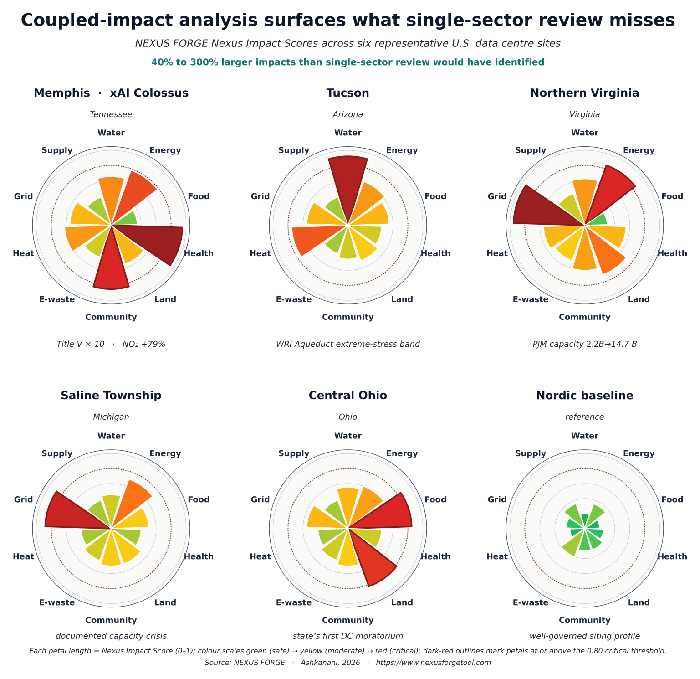
Figure 1. NEXUS FORGE Nexus Impact Scores across six representative U.S. data center sites. Each petal length corresponds to the score on one of ten coupled-impact dimensions; petal color scales green (safe) → yellow (moderate) → red (critical). Petals outlined in dark red exceed the platform's 0.80 critical-impact threshold. The Nordic baseline provides a reference profile for well-governed siting. Source: NEXUS FORGE; Ashkanani, 2026; https://www.nexusforgetool.com.
The decision-architecture frontier
What the six-site pattern reveals is that the remaining frontier in data center water efficiency is no longer in the cooling tower. Hardware-level gains have been substantial: industry-average Water Usage Effectiveness sits at approximately 1.8 L/kWh; best-in-class facilities report 0.2 L/kWh or lower; and Microsoft's newest designs are engineered for zero on-site water consumption (Walsh, 2024). Coordinated improvements across cooling, electricity sourcing, peak-demand management, and basin-level siting could still cut 2050 U.S. data center water consumption by approximately 95% relative to business-as-usual (Herrera et al., 2025). The technological pathway is established. The institutional pathway has lagged. Federal water-use disclosure for digital infrastructure does not yet exist in the United States; peak-month reporting is not required; integrated basin-scale planning that brings water utilities, public-utility commissions, technology operators, and public-health authorities into a single review remains the exception.
The next decade of U.S. infrastructure expansion will extend well beyond data centers, to hydrogen production, semiconductor fabrication, advanced desalination, and AI gigafactories, each drawing on the same coupled nexus of water, energy, land, and health. The review architecture built now for data centers is the architecture that will govern them. The first water authority to operate inside a coupled pre-permit modelling environment will not just protect a basin; it will set the template for how every major industrial siting decision of the AI era is made.


