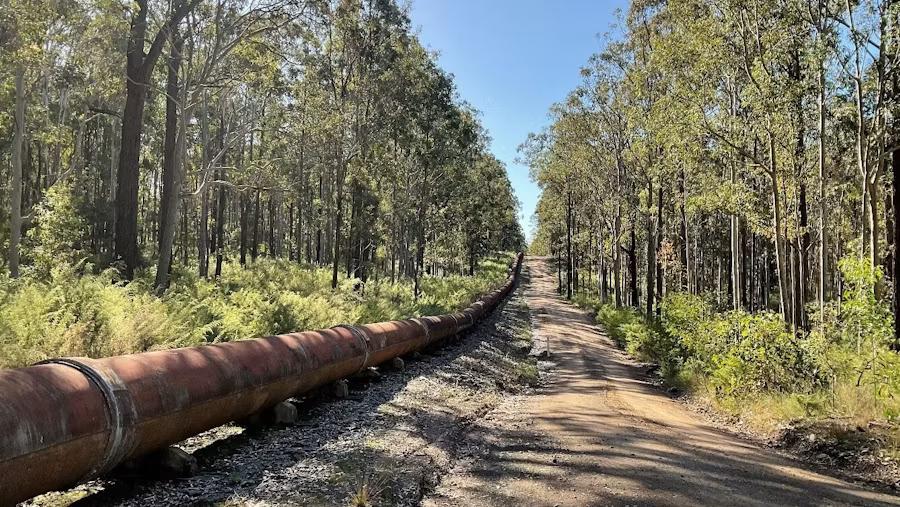
Hunter Water, the utility serving the Lower Hunter region of New South Wales, Australia, is proposing to invest more than AUD 150 million (about USD 107 million) to replace a 12-kilometre stretch of the Chichester Trunk Gravity Main (CTGM), running between Brookfield Tunnel and Burmi Creek, near Clarence Town, north of Newcastle. Built in 1923, this section of pipeline is now showing signs of deterioration and supplies around 40 per cent of the region’s drinking water, carrying it from Chichester Dam to treatment and distribution facilities that serve Newcastle and the surrounding Hunter Valley.
North of Wallaroo Creek, the replacement pipe will generally follow the existing above-ground corridor. South of it, the preferred route diverts around Columbey National Park and runs underground within an existing Transgrid powerline easement, an alignment chosen to avoid clearing roughly 6.4 hectares of forest vegetation. To limit disturbance further, Hunter Water is proposing horizontal directional drilling at three watercourse and tunnel crossings, Wallaroo Creek, Stony Creek and Brookfield Tunnel, alongside trenchless construction beneath the northern section of Parsons Road to reduce disruption to traffic. The replacement main will also be larger, growing from 900mm to 1050mm in diameter, which the utility says will improve network capacity. The existing pipeline will be decommissioned once the new one is connected.
Timeline for delivery
Justin Watts, Hunter Water’s Executive Manager Infrastructure Delivery, said the pipeline’s role in the network underpinned the case for renewal. “The Chichester Trunk Gravity Main is one of the most important assets in our network, supplying around 40 per cent of the Lower Hunter’s drinking water. The project is about planning for the long-term reliability and resilience of that supply for future generations.”
The project has been in development for over a decade, beginning with condition assessments of the main in 2015 and 2021, followed by a business case in 2022 and route selection in 2023. Concept design and environmental assessment followed in 2024, and the current phase includes gathering feedback until 4 October 2026, after which Hunter Water will finalise its assessment and reach a determination. Subject to approvals, project approval and detailed design are expected from late 2027, with construction starting in 2029 and continuing over several years.