

Water innovation is no longer just about making treatment technologies work. Meagan Mauter explains how energy constraints, system design, policy reform, and distributed water solutions are reshaping desalination, membranes, and the future of resilient water systems.
Ensuring a reliable water supply in a carbon-constrained world is one of the defining engineering challenges of the coming decades. For Meagan Mauter – Associate Professor of Civil & Environmental Engineering at Stanford University and Research Director of the National Alliance for Water Innovation (NAWI) –meeting that challenge requires rethinking not just technologies, but the entire system in which water is produced, treated, and managed.
Mauter’s work sits at the intersection of water, energy, and policy. Through her Water and Energy Efficiency for the Environment Lab (WE3Lab), she investigates how water treatment technologies, operational strategies, and regulatory frameworks can evolve to deliver sustainable water supplies while minimising energy use and emissions.
Meaningful innovation used to ask if a process works. Today, it asks if it works at scale, within cost, energy, and manufacturing constraints
At NAWI, a $110-million U.S. Department of Energy desalination hub, she helps coordinate research across universities, national laboratories, and industry to develop cost-effective technologies for treating nontraditional water sources such as brackish groundwater, industrial wastewater, and produced water.
In this conversation, Mauter discusses how the definition of innovation in water treatment has changed, why energy flexibility may offer utilities major cost savings, and how modular desalination systems could transform water supply. She also explores the realities of membrane technology, the persistent challenge of brine management, and the policy and financing barriers that slow the adoption of promising new solutions.

You often describe water supply as a challenge that must be solved within energy and carbon constraints. From your perspective, what does “meaningful innovation” in water treatment look like today, compared to a decade ago?
Meaningful innovation used to mean “Can we make this process work?” Today, it means “Can we make it work within tight cost, energy, and manufacturing constraints? Can we reliably operate it at scale in diverse settings? And can we articulate where, when, and how this technology is most valuably deployed?” Today’s innovations often move the needle at a systems level by changing how quickly a project comes online, who owns the capital debt, or how the project creates value in other sectors.
Many utilities recognise the water energy nexus conceptually, but struggle to act on it. Where do you see the biggest untapped opportunities for reducing energy use in water treatment systems right now?
Today’s water innovations often move the needle at a systems level: changing project timing, financing models, and where value is created
Water utilities typically view the water–energy nexus through an efficiency lens, but the biggest near-term cost savings opportunities are in energy flexibility–shifting when we consume electricity. Water systems are inherently flexible: they have raw and finished water storage, discretion over the timing of pumping and treatment, and control over on-site generation. Double-digit energy cost savings are possible when water utilities design and control infrastructure to shift energy-intensive operations to periods when electricity is cleaner and cheaper. We have also found that proactively investing in energy flexibility infrastructure enhances the redundancy and adaptive capacity of the system against other disruptions like drought or wet weather. In short, strategic water utilities are starting to see the coupling of water and energy systems as an asset rather than a liability.
As Research Director of the National Alliance for Water Innovation, you focus on desalinating non-traditional source waters. How does desalination of brackish water, produced water, or industrial wastewater change the technical and economic equation compared to seawater desalination?
The scale, siting, and value proposition of these projects are so different from seawater plants. They are often much smaller and more distributed, so the classic economies of scale in treatment largely disappear, and cost competitiveness has to come from economies of scale in manufacturing. The key to economic viability is designing standardised, modular systems that can be widely replicated, rapidly deployed, and robustly operated across many sites. Onsite treatment also opens the door to fit-for-purpose water, which often facilitates cost savings relative to larger plants designed to produce a single highly purity product water. Finally, onsite treatment solves two problems at once by creating a new water supply while reducing waste liability and disposal costs.

In industry, energy efficiency gains often compete with capital cost constraints. What promising approaches are emerging that can deliver both lower energy intensity and cost competitiveness?
Water utilities often focus on efficiency, but the biggest near-term savings may come from energy flexibility – shifting when energy is used
The right tradeoff between capital cost and energy intensity depends on who owns the asset and how they finance risk. A utility making a 30-year investment can justify higher upfront costs to reduce energy, chemicals, and maintenance over decades, while many industrial players face a higher cost of capital and shorter payback windows. As a result, they often prioritize low capex projects even if the opex to run them is higher. The implication for innovators is that there is value in a portfolio of technology options that span a wide range of capex-to-opex ratios. Water-as-a-service models can also help to bridge this divide by having a third party own and operate the system and sell water as an operating expense. These models lower upfront barriers to project development for the industry, while still motivating investment in high-performance treatment solutions.
Your lab is known for re-envisioning membranes rather than incrementally improving them. What fundamental assumptions about membrane design or operation do you think the industry needs to let go of?
One assumption the industry needs to let go of is that membrane performance can be optimised at one scale in isolation. In RO, spacer hydrodynamics, module geometry, and process configuration are tightly coupled. Multiscale modelling from our lab makes clear that “better” at the material’s level or spacer level can be neutral or even detrimental once mass transfer, pressure drop, packing density, staging, and recovery targets are fully accounted for.
Water systems already have flexibility through storage, pumping schedules, and onsite generation, which can unlock double-digit energy savings
A second assumption is that fouling can be treated as a fixed penalty factor during system design and controlled through threshold-based heuristics during plant operation. We need designs, monitoring, and control tools that treat fouling as a measurable system state, and we need to more effectively translate the effects of fouling into interpretable impacts on system-level cost, energy, uptime, and membrane life.
Finally, we need to let go of the assumption that membranes drive the lifecycle costs of RO systems. Accepting accelerated membrane fouling and replacement can be economically optimal when it allows you to reduce pretreatment infrastructure or shift your energy consumption to cheaper and cleaner times of day.
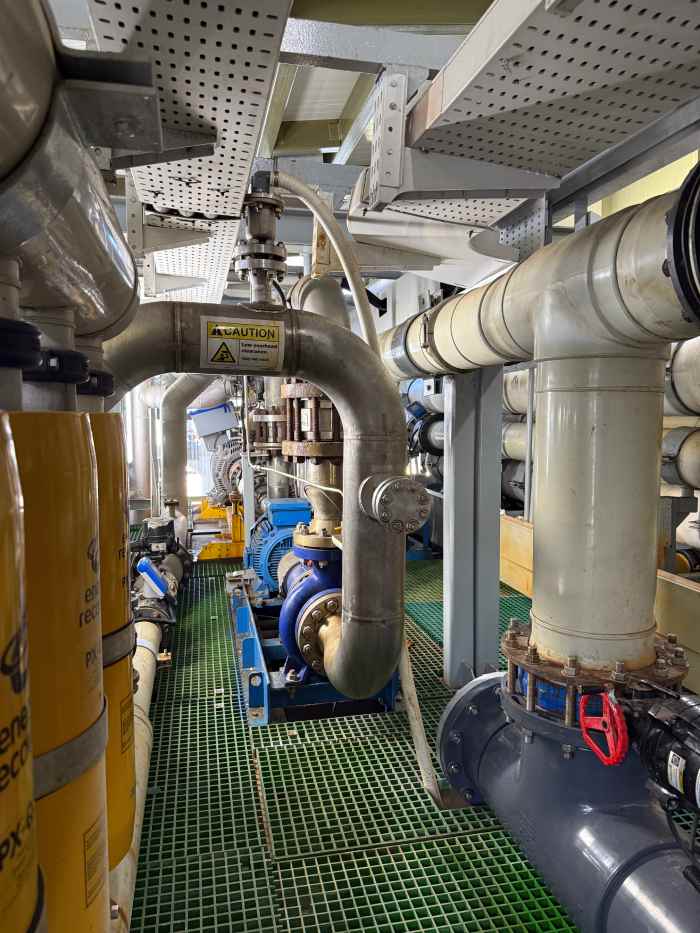
The WE3Lab has partnered extensively with municipal water utilities to minimise the operating costs of their most energy-intensive assets, including desalination plants (pictured here), water reuse facilities, wastewater treatment plants, and water distribution systems.
How do advances in membrane materials translate into real-world system performance, and where do you most often see a disconnect between lab breakthroughs and full-scale deployment?
Advances in membrane materials translate into real-world system performance only when they change the constraints that actually drive plant cost and reliability. Today, RO membrane performance is mostly limited by concentration polarisation, pressure tolerance, and susceptibility to chemical degradation. This means that a higher flux or more selective material delivers marginal benefits unless the membrane design is co-optimised with process design and operation.
Another persistent gap is manufacturability. Many new materials cannot be made defect-free as ultrathin films, produced roll-to-roll at industry-relevant rates and widths, or assembled into standard spiral-wound modules that drop into existing skids. As a result, many impressive membranes lab results have never really displaced the polyamide thin‑film composite developed in the 1960’s.
With smaller, distributed desalination projects, classic economies of scale disappear, and cost competitiveness comes from manufacturing
Finally, labs often struggle to value tradeoffs in membrane performance and cost. Anti-fouling membrane materials that cost 3x, for example, might not be as valuable to the operator as lower-cost conventional membranes that you simply replace twice as frequently.
That doesn’t mean that there isn’t any great work going on in membrane innovation today. Labs developing new materials are seeing success when they have a clear value proposition in treating a waste stream that can’t currently be treated with membranes. It’s important to remember just how space and energy-efficient membranes are relative to other separation processes.
Brine and concentrate management remains a major bottleneck for desalination and advanced treatment. What innovative strategies, technical or policy-driven, do you find most promising for addressing this challenge?
Standardised, modular treatment systems that can be replicated and rapidly deployed will be key to making decentralised desalination viable
Brine management is a siting, permitting, and liability problem as much as it is a technology problem. The most promising strategies start by maximising opportunities for onsite reuse or coupling a brine volume minimisation technology with a clear off-take strategy. High recovery processes like osmotically assisted RO, low salt rejection RO and high pressure RO are all seeing the inklings of commercial traction in this space. Selective separation processes that recover high-value constituents like lithium or magnesium or generate commodity products like acids and base from the brine can also be beneficial, so long as there is a stable and local offtake market. We definitely see a role for policy and state and federal incentives that encourage co-locating facilities to share concentrate infrastructure, create fast and clear permitting pathways for beneficial use, and support pilots that de-risk new concentrate treatment approaches for diverse end-use applications.

Beyond reducing energy consumption, where do you see opportunities to recover energy or valuable resources within water treatment processes and move toward more circular systems?
The right balance between capital cost and energy savings depends heavily on who owns the asset and how that investment risk is financed
Resource recovery is an attractive vision, but adoption has been limited because most water treatment residuals are low-grade and produced at relatively small scales. This makes separation, purification, and transportation disproportionately expensive. In many cases, the only real value proposition is in producing feedstocks that are consumed onsite. There are certainly some exceptions where resource recovery is solving a broader problem, like the absence of brine disposal, or where the facility is already co-located in an industrial ecosystem, but these can be special cases. Onsite biogas generation at wastewater utilities is much more widespread, and we see very strong value propositions for large facilities co-digesting organic waste and located in high-priced power grids. Going forward, I see promise in treatment plants designed for adaptability, so a plant built to last 30 years can shift operating modes as electricity and chemical prices change, and as potential outputs like commodity chemicals or critical minerals move in and out of economic viability.
From your research, how do current water policies and regulatory frameworks either enable or limit innovation in advanced treatment and desalination technologies?
Current policy and regulatory frameworks can both protect communities and the environment and unintentionally slow innovation and drive up system costs, especially for desalination and advanced treatment plants, where permitting is complex, multi-agency, and often sequential. Our recent work documented substantial water system cost savings from reforms that increased the pace and predictability of permitting. Faster permitting reduces anticipatory construction of desalination plants – basically building capacity in anticipation of a bad drought – and enables adaptive, just-in-time deployment of treatment capacity when water availability, storage, and use thresholds are crossed. This means that you actually end up building and operating desalination capacity much less frequently, which, of course, lowers both system costs and environmental impacts.
As both an academic researcher and a national research leader, what are the biggest barriers preventing early-stage water treatment innovations from being adopted by utilities and industry, and how can those barriers realistically be lowered?
Brine management is as much a siting and permitting challenge as a technical one, requiring both treatment innovation and policy solutions
The biggest barriers are not a lack of good ideas, but the gap between what early-stage innovations can promise and what utilities and industrial operators are accountable for delivering: continuous compliance, high uptime, and predictable (low) costs. New technologies often arrive without long-duration pilot data, clear pathways for permitting, or integration pathways that fit within existing infrastructure, staffing, and procurement rules. Risk is amplified by fragmented responsibilities across designers, vendors, operators, and regulators, which makes it hard to assign performance guarantees. Lowering these barriers has historically meant investing in shared pilot and demonstration platforms, but we have also seen first-hand how expensive these pilots can be and how difficult it is to abstract from one site to another.

This is where in silico design tools, like the open-sourced process systems engineering platform and technoeconomic platform WaterTAP, can be transformative. By coupling process models with technoeconomic analysis and uncertainty/sensitivity methods, WaterTAP is helping NAWI projects screen process configurations across a much wider range of source waters, identify which assumptions actually drive cost and reliability, and design pilots to answer the highest-value questions rather than simply “trying something”. Digital workflows don’t replace field validation, but they can reduce the number of pilots required, improve how transferable pilot learnings are, and help utilities and industrial partners move from one-off demonstrations to repeatable and financeable deployment pathways.
Directing a national DOE-funded research hub requires coordination across universities, national labs, and industry. What have you learned about fostering innovation at scale, and how does that differ from leading a university research lab?
A real success would link water treatment design with water and energy planning, so what we build depends on when and how it will operate
Directing a hub like NAWI reinforces how inherently multidisciplinary water innovation is. A very rewarding part of my job has been figuring out what different partners can uniquely contribute. Universities bring new concepts and analytical depth, national labs bring characterisation facilities and scale-up infrastructure, and industry brings integration experience and real-world insights into what drives adoption. NAWI’s vision has been to drive innovation by intentionally connecting those strengths with water utilities’ operational realities.
If we revisit this conversation ten years from now, what changes in water treatment technology or in how we manage water systems would you consider a true success?
Ten years from now, I would be thrilled if we have more effectively merged water treatment design with water and energy resources planning. Decisions about what to build would become inseparable from decisions about where, when, and how to operate those facilities. That means delivering planning models that can evaluate portfolios of options using realistic treatment performance, cost, and reliability assumptions, and treatment design tools that are built to answer planning questions under a range of plausible futures and operating conditions. On the technology side, I think that a big part of delivering water security at low cost is going to come from intentionally integrating distributed, fit-for-purpose reuse into centralised networks so it functions as a coordinated resilience asset. And on the planning side, it is going to come through adaptive deployment of these non-traditional supplies, enabled by faster permitting and better decision support tools that account for both water and energy system constraints.


