Opinion

Von der Leyen talks about crop water needs: A list of populisms necessary but not sufficient conditions
Last week Olivia Tempest wrote the news piece “Von der Leyen announces a new European Water Initiative amid shortage risks“. In the article, the word water appears 28 times, the word agriculture 2 times, and the word irr
Last week Olivia Tempest wrote the news piece “Von der Leyen announces a new European Water Initiative amid shortage risks“.
In the article, the word water appears 28 times, the word agriculture 2 times, and the word irrigation 0 times. The third paragraph of the piece states: «Crops need water to grow, and livestock need it to survive. Entire harvests depend on it». What happened in Europe this summer should make us reflect on water management in European river basins amid the climate crisis.
Yesterday afternoon, Francesc Reguant’s book “Two Agricultures, Both Necessary. Food Production Facing the Challenge of Global Sustainability“, published by Cajamar, was presented at the Lleida College of Economists. You can download the book here.
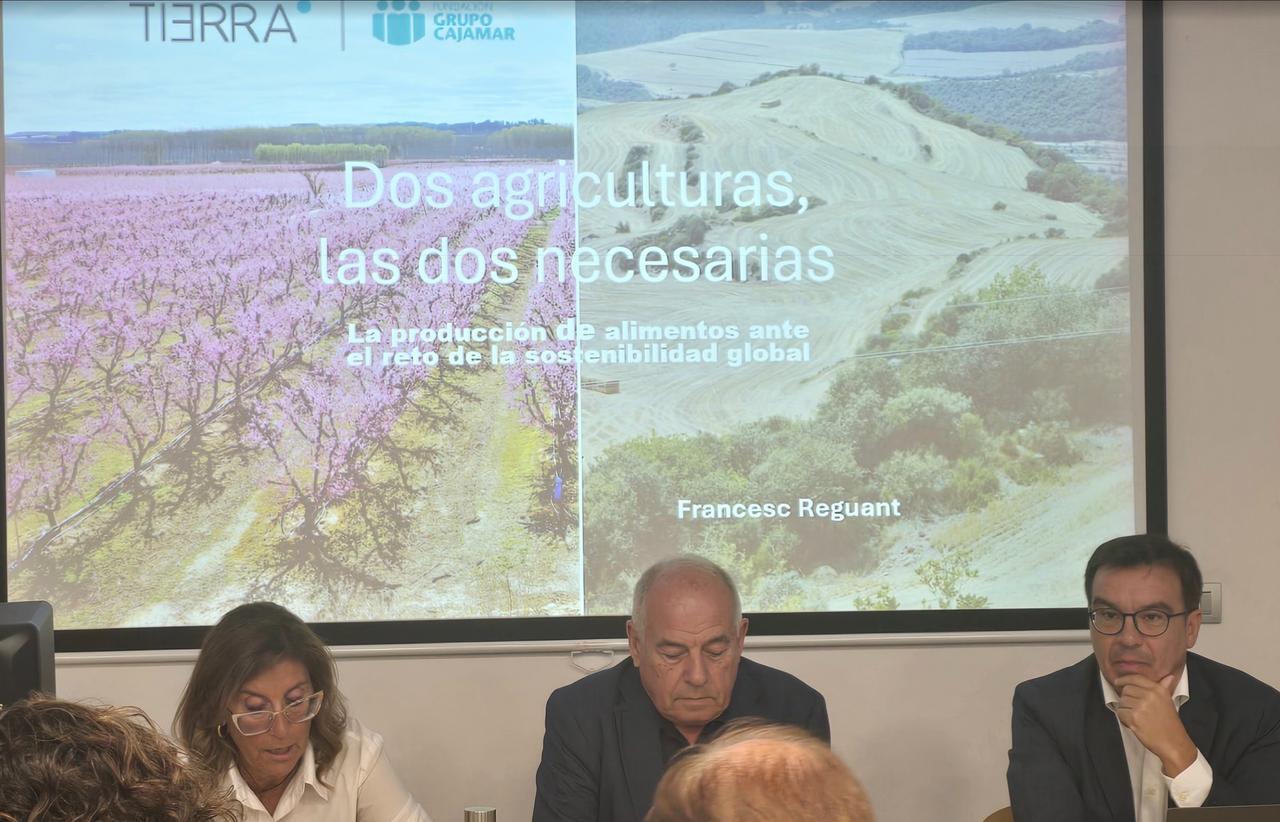
Francesc explained that food production must be sufficient, viable, healthy, affordable for consumers, and eco-responsible all at once, and that achieving all of this is complex. The term Sustainable Intensification (irrigated agriculture, regenerative agriculture, precision agriculture, bioeconomy, intensive livestock farming, etc.) was used by the FAO in 2008, and later by the IPCC in 2023.
I liked the slide where Francesc shared some “viability thieves”:
- Small scale.
- Mountain terrain.
- Rainfed farming (dry farming).
- Bureaucracy.
- Over-regulation.
- Utopias and populism.
Rainfed farming is simply the absence of irrigation, and I’ll now go through some populisms in the form of necessary but not sufficient conditions related to water management.
- Water policy in Europe must improve the urban water cycle, but it must also understand irrigation as rural backbone infrastructure. The timeframes being handled in the water resilience strategy don’t align with the timelines for rural development works.
- Agriculture is a necessary condition to guarantee food sovereignty in Europe, but not a sufficient one when we factor in the climate crisis. The climate crisis is causing a shift in the altitude/latitude of irrigated areas — an effect I already flagged back in 2019. You don’t need to run terabyte-scale models to predict a drop in production and in Europe’s food sovereignty if we see more years like this one. On Sunday I was told that France will post its worst yield on record this year, and Catalan public broadcaster 3/24 also reported that in Catalonia the combination of extreme heat and spider mites could cut corn yields from 15 t/ha to 8-9 t/ha.
- Modernization improves efficient use, but it doesn’t always mean water savings. Measuring volumes is relatively easy; measuring savings is not. In an irrigation season with high ETo and no rainfall, needs are greater. I’ve seen effective rainfall during the crop cycle drop from 400 mm to figures close to 90 mm. On top of that, we can add crop changes, and so on. The production curve defines the relationship between evapotranspired water and yield.
- Measuring volumes helps; measuring application rates improves use and governance. We frequently measure the volumes passing through a system’s various meters or flow meters to identify Non-Registered Water, but we make little progress in analyzing whether the water applied is actually what the crop needs. What genuinely improves the use and governance of irrigation water is knowing the irrigation doses (volume per unit area) being applied across different plots.
- Two-part (binomial) tariffs improve water use, but it depends on the variable term. Often, simply having a two-part tariff structure is enough to access certain funding lines. Irrigation water tariffs with high variable costs drive farmers to abandon the activity, but if that variable cost has too shallow a slope, it doesn’t sufficiently incentivize optimizing water use. In these cases, it can help to define progressive two-part tariffs beyond certain allocation thresholds.
- Digitalization is necessary, but not sufficient, because you need technical staff to extract value from the data. After rolling out the PERTE programs, ongoing maintenance and technical capacity-building must be guaranteed to extract value from the data.