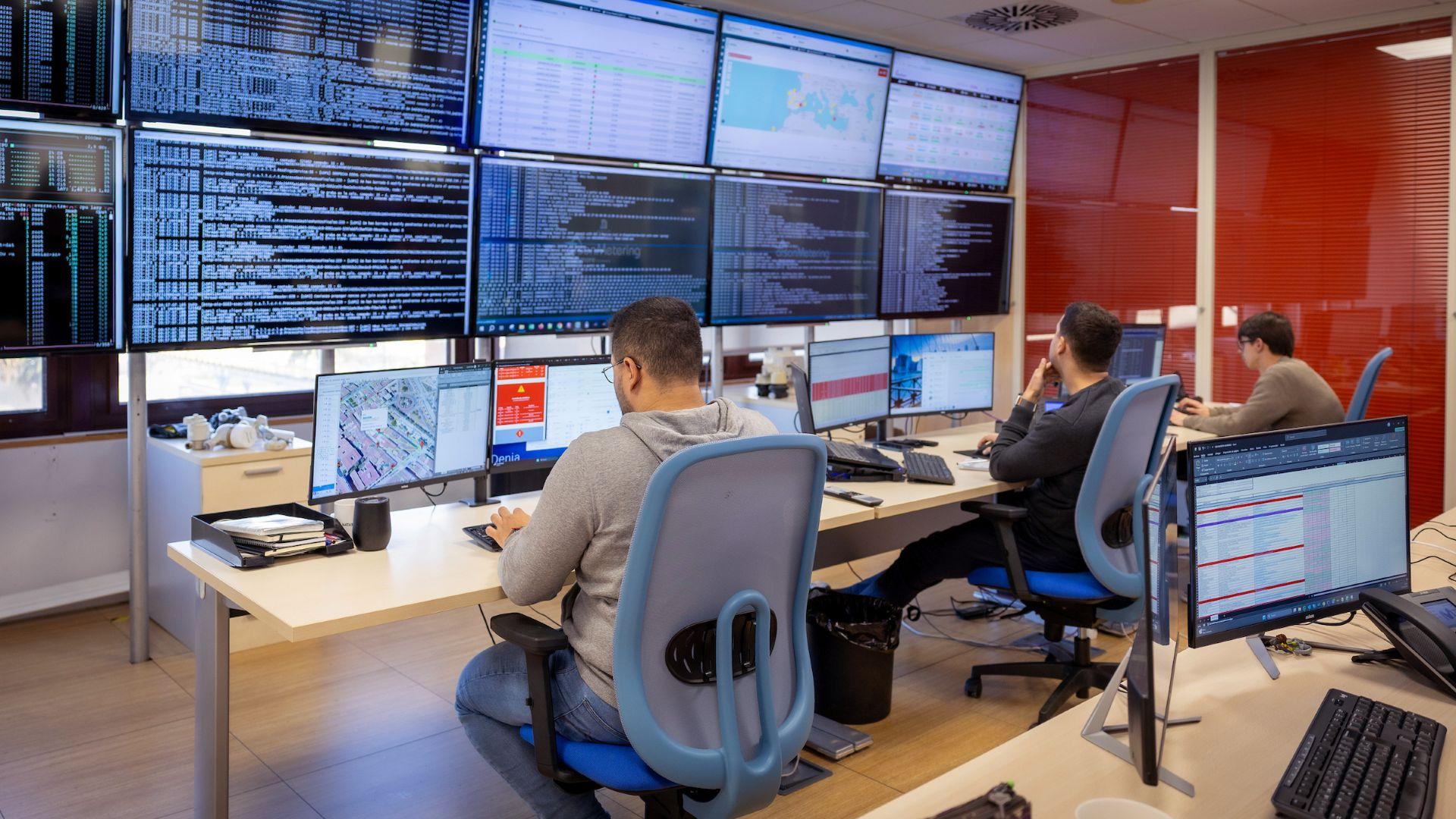
On October 23, 2025, HMS Networks and Smart Water Magazine hosted the webinar Shaping the Future of Water: Sustainability, Cybersecurity & Smarter Operations in Practice. The event gathered experts from technology, cybersecurity, and policy to discuss how digital transformation and resilience are redefining the water industry.
The discussion explored how utilities and operators can turn data into value while safeguarding critical infrastructure. The conversation made one thing clear: digitalisation and cybersecurity are inseparable. To build the water systems of the future, utilities must combine connectivity and intelligence with security and trust.
The panel featured Xavier Cardeña, Market Manager at HMS Networks; Philip Lander, Software Product Owner at inCTRL Solutions; Eric Gervais, Chief Information Security Officer at SKion Water; and Gijs van Loon, Cyber Researcher and Workshop Facilitator.
Smart Water in practice
Opening the discussion, Xavier Cardeña emphasized that digitalisation and automation are fundamental to achieving efficiency, flexibility, and competitiveness in today’s water management landscape. He described smart water as “the combination of systems — connectivity, data, and automation — that make water truly smart,” and pointed to the growing need to optimize limited resources through digital tools.
“Start small, with pilot projects that can demonstrate quick wins, that can be scaled up with an affordable budget” – Xavier Cardeña
For Cardeña, the most successful digital journeys start small. “Start with pilot projects that can demonstrate quick wins and be scaled up,” he advised. Too many projects, he observed, lose momentum because their objectives are vague or their timelines unrealistic. Reliable, connected data must come first. “Before analysing the data, make sure you can trust the data you’re analysing,” he added.
The benefits, he said, reach every level of the water value chain. Integrators gain new service models such as remote monitoring and performance optimization. Industrial users can outsource specialized tasks while maintaining compliance and efficiency. Utilities can centralize operations and benefit from shared infrastructure. “Without data, there is no intelligence, so connectivity is the basis,” Cardeña summarized.

From connectivity to cloud intelligence
Philip Lander expanded on these ideas, focusing on how cloud-based data and monitoring systems are already changing daily operations. “The greater the distance between the operation and the people who need to monitor, the greater the benefit in remote monitoring,” he said. He described examples ranging from mobile wastewater trailers in the United States to large manufacturing plants where operators now track equipment performance directly from their phones.
“A digital initiative should be focused on value — be intentional about the value, and flow everything from that edict” – Philip Lander
Cloud-native solutions, he explained, simplify asset management and maintenance by integrating multiple functions into a single platform. “Technicians can digitise standard procedures, attach photos, and access manuals on their phones — all in one place,” he said. For small and medium-sized utilities, this integration reduces complexity and supports operational continuity without requiring extensive IT resources.
Data sharing, according to Lander, is also redefining supplier–customer relationships. He cited membrane manufacturers that now maintain long-term data connections with clients to provide better service and optimize warranties. “It’s a win-win,” he explained. “The supplier can absolutely help the customer, but it’s really important to be clear about who owns the data.”
Both Lander and Cardeña agreed that while technology is ready, cultural adaptation remains a challenge. Integrating digital systems requires a shift in mindset as much as in hardware. “Digitalisation stops feeling like a threat and starts feeling like an opportunity,” said Cardeña.

Cybersecurity: from barrier to enabler
The conversation then turned to the security dimension of digital transformation. Eric Gervais pointed out that many still perceive cybersecurity as a hindrance to innovation. “Today we all know cybersecurity is important for OT and digitalisation, but there are still misconceptions,” he said. Too often, utilities assume they are too small to be targeted or safe because they are isolated from the internet. “Maybe that was true in the past, but today IT and OT are converging. Not having a plan in cybersecurity is planning to fail.”
“Hacktivists are showing willingness to cause cyber-physical impact — this is something we need to take seriously” – Gijs van Loon
For Gervais, cybersecurity should not be seen as a constraint but as part of the foundation that supports digital progress. “It should be part of early discussions — an enabler of effective digitalisation efforts, not in conflict with them,” he said. The key is to frame security as an essential component of operational reliability and resilience.
Gijs van Loon brought an international perspective, highlighting a new form of risk: escalatory hacktivism. “Hacktivists are showing willingness to cause cyber-physical impact — this is something we need to take seriously,” he warned. He referenced recent politically motivated attacks on water infrastructure in Europe and North America linked to ongoing conflicts. Such incidents, he noted, demonstrate how ideological motives can overlap with state interests, increasing the threat to critical systems.
Van Loon, co-author of Under Pressure: Securing Europe’s Resource-Constrained Critical Infrastructure, argued that water infrastructure must be recognized as a strategic asset that deserves stronger political protection. “States should use appropriate diplomatic measures to hold malicious actors accountable and signal that cyberattacks on water infrastructure will have real consequences,” he said.

Practical steps for operators
“Start small, start now, be consistent about it — chip away at your cybersecurity gaps and improve your posture” – Eric Gervais
Bringing the focus back to operations, Gervais outlined practical steps that water utilities can take to strengthen their defences. He recommended starting with the SANS Institute’s five ICS critical controls, which include incident response readiness, network segmentation, continuous monitoring, secure remote access, and risk-based vulnerability management. He compared them to a hierarchy of needs: the basic requirements that every operator must meet before advancing toward higher cyber maturity. “Start small, start now, be consistent about it — chip away at your cybersecurity gaps and improve your posture,” he said.
Van Loon reinforced that collaboration is just as vital as technology. He encouraged companies to share knowledge and practice response scenarios together. “Look at your company processes from the perspective of a criminal group, and practice with that. Exchange information and work together on solving those issues,” he advised.
Smart Water solutions in action
The panel also highlighted real-world applications where smart water is already delivering measurable benefits. Cardeña presented the case of an Italian manufacturer of industrial evaporators that implemented HMS Networks’ remote access solution, cutting annual service travel by more than €200,000 and improving response times. “Remote experts can now assist customers immediately,” he said. “Operations continue even when specialists are not on-site.”
He also pointed to advances in intelligent monitoring, where alerts and dashboards enable rapid responses to anomalies in pumps, pressure, and temperature. Some utilities, he noted, have achieved energy savings of up to 30% through optimized operation of pumps and blowers.
Lander added examples from the analytics side. He described a U.S. utility, Metro Water Recovery in Denver, that uses control-loop performance monitoring to keep operations compliant while controlling energy costs. In another case, a biogas plant leveraged centralized data and KPIs to detect early process upsets and optimize biogas output. For Lander, these examples show that smart water is not a distant vision but an achievable reality.

Insights for the road ahead
As the discussion progressed, the panellists reflected on what will define the next phase of smart water implementation. Philip Lander emphasized that digital transformation must be purposeful: “A digital initiative should be focused on value — be intentional about the value, and flow everything from that edict.” For him, progress depends on ensuring that every technological step creates clear operational or environmental benefit.
Eric Gervais underlined the need for sustained attention to cybersecurity as a living, evolving discipline. He urged organizations to involve their teams in continuous improvement and training. “Talk about cybersecurity risk in business language,” he said. “Work with trusted providers, start small, and be consistent. This will go a long way to support smart water digitalisation efforts.”
Gijs van Loon focused on collaboration as the key to resilience. “Innovative efforts and cybersecurity go hand in hand,” he said. “Have a look at your company processes from the perspective of a criminal group and collaborate across the sector to strengthen defences.” He reiterated that sharing information between utilities, governments, and experts is essential to stay ahead of emerging risks.
Finally, Xavier Cardeña offered a message of optimism about the path forward. “It’s not necessary to do it alone — this is a moment of partnerships,” he said. He noted that technology is ready, expertise exists, and what remains is the willingness to work together. For Cardeña, the water sector stands at a pivotal moment — one defined not by individual systems but by cooperation, innovation, and shared purpose toward a smarter, safer, and more sustainable water future.